Sunday, 28 October 2012

The Things They Say... (Part 4.) What a beautiful skirt.

We've been practising 'paying compliments' this week, while going through the register. 
'What a nice new haircut you've got today, Vicente,'
'Thank you, Meesa Deee.'
'What a beautiful watch you've got there, María.'
'Thank you, Meesa Dee, ees present from my tío.'
'Uncle.'
'Yes, uncle.'
That kinda stuff.
María-José and a gang of her amigas pelt across the playground towards me this morning. 
'Meesa Deee! Meesa Deee! What beautiful skirt you wearing!' María-José yelps, breathlessly.
I give María-Jose my '100% puzzled' look, (it gets a lot of outings), and check to see that, yes indeed, I am wearing trousers today. 'Skirt?' I enquire.
'Yes, you thees!' she confirms, tugging at my sleeve.
'That's a shirt,' I correct, gently, emphasising the 'shhhhhh' bit. 'Ss-kirt is falda.' (I'm learning a bit of Spanish and happen to know this word.)
María-José's mouth gapes. Her mates squeal delightedly and hop from foot to foot with unbridled glee at María-José's faux pas. I guess, if you're six or seven years-old, telling your male teacher that he's wearing a beautiful skirt must be a seriously outrageous event.
I give María-José a house-point anyway, just for brightening up our day. She's red-faced, but happy with the outcome, and I enter school with a huge smile on my face.
Who says you have to get everything right? 

If you like the blog why not read the eBook? Zen Kyu Maestro, An English Teacher's Spanish Adventure available from Amazon. 
For a free sample chapter, click HERE.


Thursday, 11 October 2012

Sevilla's Gigantic New Waffle in the Sky

Most visitors to Sevilla will visit la Giralda, Plaza de España, the Real Alcázar, maybe take a cruise along the Rio Guadalquivir. But how many visit the Gigantic Waffle in the Sky?
 
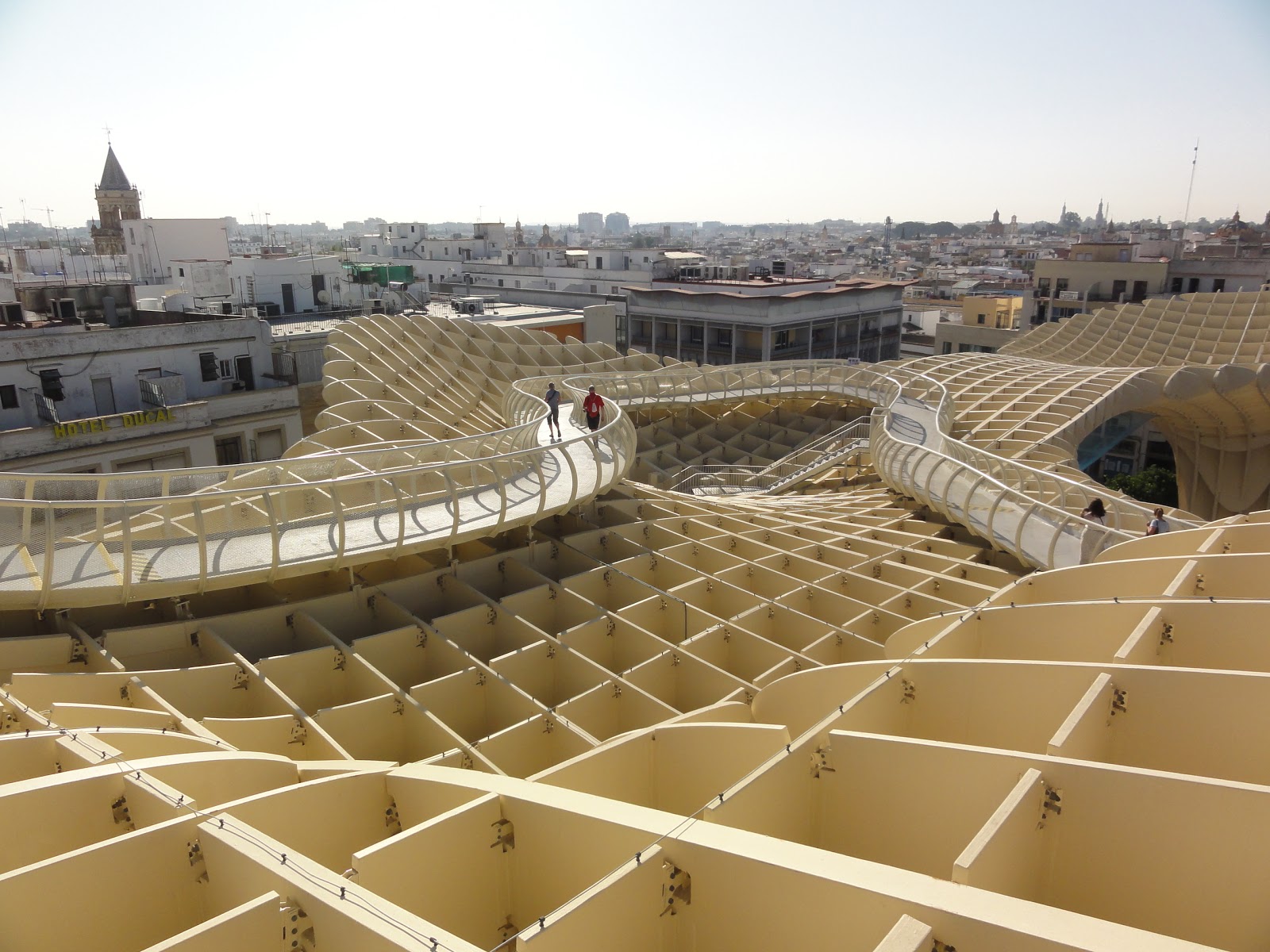
Opened in May 2011, the Espacio Metropol Parasol (to give it its official title) is hard to describe and almost impossible to categorise. Think Ciudad de las Artes y las Ciencias in Valencia. Think Museo Guggenheim in Bilbao. Think gigantic undulating waffle, the size of a football pitch, suspended 30 metres up in the air. 

I'll let a few pictures speak, as I'm clearly going to struggle to find words to do justice to this place.

The view across Calle Imagen into Plaza de la Encarnación.

From the top of Calle Regina.

The Plaza level at Calle Regina end, showing three of the six concrete 'trunks'.
The 16th century Iglesia de la Anunciación provides a stark contrast viewed from the Plaza level.


Beginning to get the idea now? Variously described in the official literature as 'parasols' or 'mushrooms', even the city doesn't seem to know what it has done to itself. Formerly a dilapidated market/car-park/bus station, the Espacio Metropol Parasol (designed by German architect Jürgen Mayer) houses an underground museum of Roman and Arabic finds, ground level hosts a new market, cafes and bars, while the plaza level provides a large public space ready-made for concerts, celebrations and demonstrations. From these levels, the mushroom/waffle/parasol roof provides welcome shade from the blistering sun, and a stark architectural contrast to some of the surrounding churches and other buildings. But ride the lift to the 'Mirador' level, and even those who have complained that the waffles are 'out of place/proportion' will gasp at the sheer audacity of the landscape that awaits, nearly 30m above ground level


La Iglesia de la Anunciación now seems to float on a waffle sea.
From the Mirador level, some of the 16 million screws and bolts holding the 3,500 wooden pieces together are clearly visible. Let's hope the constructors liked doing jigsaws...

A 250m pathway provides views over the city.


The view from one of the cafés.


It took me a few minutes to register the views, so engrossed was I in the almost alien landscape that opened up in front of me. Here, the giant undulating waffle hosts a weird and somewhat wacky 250m pathway, a sort of walking roller coaster ride. It's a dream venue for photographers, so unusual are the sights and so stark the contrasts. There are more bars and a restaurant if you need a break from the sun, or time to delete some snaps to make room for more stunning vistas.

No, there wasn't a helicopter ride. A snap of one of the many information boards shows the view from above.


It won't be to everybody's taste, that's for sure. But the Gigantic Waffle in the Sky can't be ignored. Pay a visit, go with friends, then spend the next hours, days even, debating its merits or otherwise. One in our party couldn't stand the place from ground level, but couldn't resist it from the Mirador. One thing I suppose I can guarantee is a good debate. 

At least there shouldn't be too much waffle. 

Website: Espacio Metropol Parasol Sevilla  Mirador access, 10:30-00:00 Sunday-Thursday, 10:30-01:00 Friday-Saturday. 
1.35 euros admission for non-residents of Sevilla.

If you like the blog why not read the eBook? Zen Kyu Maestro, An English Teacher's Spanish Adventure available from Amazon. 
For a free sample chapter, click HERE.


Sunday, 26 August 2012

You can't get a ticket for the Clásico

Well, so I've been told many times during my six years here. And so I've repeated to anyone who's asked. But, I've recently discovered, there are Clásicos and there are Clásicos.

A Champions League encounter? Best to forget it. Unless you know someone. Really know them.
La Liga? Just as unlikely. Even if it's the first of the season and the awarding of titles and medals is a long season away.
Copa del Rey? Again, even a meeting in an 'earlier' round will undoubtedly be well and truly sold out.
Supercopa? What-a-copa?

The Supercopa de Eapaña de fútbol is the equivalent of the English 'Community Shield'. Winners of the cup (Copa del Rey) against the winners of the league (la Liga). So that will be Barcelona against Real Madrid, over two legs, at the fag-end of August just as the season is kicking off and just as many Spaniards are still on their holidays...

I trawl the FC Barcelona website and find that tickets are on sale! To members. My less-than-perfect Spanish is put to the extreme test and I discover that after a certain time, unsold tickets will be available to the great unwashed, the non-member, general public. That will be me. 

So, on the due date, I cross my fingers and toes and make sure my credit card is alive and kicking. There are hundreds of tickets available. Thousands. Tens of thousands. Barcelona offers its members the opportunity to return their season tickets for resale, if they cannot make any particular game. It seems that my hunch about a What-a-copa clásico at the tail-end of August is correct. I grab a couple of seats @ 65 euros apiece, near the corner flag at the front of the middle tier (there are three) and have trouble believing they will be kosher as they chug out of the printer in the back bedroom.

Camp Nou, Barcelona, without doubt one of the best club grounds in the world.
But my doubts are groundless. There is a huge crowd outside Camp Nou more than an hour before the 22.30 kick-off time. (Official attendance was nearly 92,000, capacity 98,000.) But although it is noisy and boisterous and there are a smattering of white shirts amongst a sea of scarlet and blue, it is peaceful and good natured. Nearly everyone seems to have a vuvuzela. (Did I mention it was noisy?)


The first half is cagey, although Barca dominate possession. The second half explodes. Ronaldo scores with a header from a corner. Pedro equalises within a minute. Messi puts Barca ahead from the penalty spot before Xavi scores a third after sublime work from Iniesta. Then Messi has an opportunity to bury the second leg by making it 4-1 but Casillas foils him brilliantly. At the other end, the Barca portero, Valdes, makes a pig's ear out of a simple clearance and Di María puts the second leg on a knife-edge, hauling Mardrid back to 3-2.


Final score, now for the second leg. But on the telly.


Game on for the second leg at the Bernabeu next Wednesday 29th August. I zip along to the Real Madrid website. Just to see... But that late Di María strike seems to have made the second leg a 'must-see'. While there are still about 50 seats available, most of them are VIP and the cheapest is 275 euros. 

Think I'll watch this Clásico on the telly.

My tips for this season? Barca for La Liga. (And Madrid for la Copa del Rey!)

A P.S. Real won the second leg 2-1, making the final score 4-4 and giving the cup to them on away goals, 6-5.

If you like the blog why not read the eBook? Zen Kyu Maestro, An English Teacher's Spanish Adventure available from Amazon. 
For a free sample chapter, click HERE.


Saturday, 18 August 2012

The Things They Say... (Part 3.) Mr. Arsehole

"Have you got Mr. Arsehole?"

My ears prick-up immediately. You know you're meant to be able to tune-in to your name if it's spoken in a crowded room? Well, teachers tune-in to bad language with the same radar-like precision. (Unless my name is 'Arsehole'...)


My class of Spanish seven-year-olds are doing 'activities', carefully chosen to give them opportunities to speak English. A group of girls are playing 'Happy Families' in the far corner. 

At the beginning of the year I provided them with laminated sheets of required vocab, 'Have you got...?' 'Yes, here you are.' 'Thanks very much.' 'No, sorry, I haven't.' That sort of thing. Over the months, the children used them less frequently. Now they don't need them any more. But where did they get that word?!

I move quickly over to where they're 'playing'. There's no furtive giggling behind grubby little fingers. They seem quite relaxed. I move in closer. I'm sure it was María who'd asked. I sidle up behind her hand. She has Miss Pipe the Plumber's daughter, Mrs. Siren the Policewoman and- Ah, now I see it. All is explained and relief floods my veins.

She has a set of three and is searching for the fourth. She has Mrs., Miss and Master, and only needs the postman to complete the set.

Mr. Parcel.

Time to get my ears syringed, perhaps?


If you like the blog why not read the eBook? Zen Kyu Maestro, An English Teacher's Spanish Adventure available from Amazon. 
For a free sample chapter, click HERE.


Saturday, 21 July 2012

Sinatra by the Sea

Spain has a long musical tradition. From Flamenco in the south to Sinatra in Castellón. Well, that's Sinatra as performed by the Banda Municipal de Castellón as part of their 10th annual season of Conciertos en el Templete del Grao. (Concerts in the bandstand of the Port of Castellón.)
Many Spanish towns boast a bandstand, and it's a real treat to hear a free concert, often on a Sunday lunchtime or (as this one) a summer evening. So the next time you visit Spain, get to work on google to find your nearest bandstand. Then sit back and enjoy a traditional Spanish pastime. Music al fresco.

Click on the link (below) for a short taste.

New York, New York, Castellón 

If you like the blog why not read the eBook? Zen Kyu Maestro, An English Teacher's Spanish Adventure available from Amazon. 
For a free sample chapter, click HERE.


Sunday, 17 June 2012

The Things They Say... (Part 2.) So you think you know how to speak English?

It's a question I ask myself more and more often. In fact, the more time I spend teaching young Spaniards in English, the more I realise how little I know about the (English) language. It's not that I can't speak, read and write English, at least reasonably well. I might not be that hot on the English subjunctive, but I get by without too many complaints. What surprises me (time and time again) is how much I know, but don't know how I know it. An example might help.

Jaume is in the hot-seat. It's a lesson we do every week. One child sits at the front and fields questions from the rest. I translate the questions and answers into English and write the answers on the board. By translate, I don't mean that they ask and answer questions in Spanish...

María: "How many years you haf?"
Me: "How old are you?"
María: "How old are you?"
Jaume: "I haf seven years."
Me: "I am seven years old."
Jaume: "I am seven years old."
I then write, 'Jaume is seven years old,' on the board and we move on.

José: "You haf mascota?"
Me: "Do you have any pets?" (You see how a little knowledge of Spanish can keep your English lesson on the road?)
José: "You haf pets?" (I let this go. He's taken one bit on board, that's plenty for today.)
Jaume: "I haf dog."
Me: "I have a dog."
Jaume: (Suddenly looking at me with great interest), "You haf dog tambien?" (Tambien means 'as well'.)

We usually (eventually) end up with six or eight reasonable sentences which we all read together. Then I choose a couple of children to read them alone. Then I help Jaume turn, 'He is seven years old,' into 'I am seven years old.' Finally, they all copy the passage into their books and at the end of all this we (they) draw Jaume and his family, friends (and dog). I am a teacher of relatively 'mature' years, so the freedom offered here, to resurrect the ancient practice of adding a little 'drawing' to an appropriate piece of work, is something I like to make use of every now and again. I don't remember a diktat ever arriving from London (when I worked in the UK) saying 'thou shalt not draw pictures in your English books,' but the practice seemed to die when English was morphing into literacy. 

Back in my sunny classroom, the regular repetition of questions and answers helps the children to pick up the English structures and over the weeks we write more sentences and make fewer mistakes. They'll each end up with a little book full of lots of information about all their friends which they can take home and treasure (or turn into paper aeroplanes).

But every now and again something happens which makes me really think...

Laura: "What your best toy?"
Me: "What is your favourite toy?"
Laura: "What your favourite toy?"
Jaume: "Emmm..." (Spaniards say, 'Emmm,' where we say, 'Ummm.' Haven't discovered why yet...) "I haf cat."
Now, it crosses my mind that maybe Jaume is getting his toys mixed up with his pets, but, it's also possible that he does indeed have a toy cat. So I delve a little deeper.
Me: "What sort of cat is it?"
Jaume: (Suddenly very excited), "Ees cat beeg!" (He holds his arms out in a 'one-that-got-away' this big pose.) They do this a lot, put adjectives after the noun, it's how it's done in Spanish. I remind him (we've done this before) how to say it 'properly'. 
"Oh, a big cat," I say.
Jaume: "Yes, black beeg cat."

It's on the tip of my tongue to correct him. It's, ´Big black cat,' isn't it? Isn't it?
I went to school in the 1970s. We did a lot of 'story-writing' in our English lessons. (We were also allowed to draw lots of pictures in our 'story books.') Traditional 'grammar' was very much 'out of fashion' although I do remember learning that a gang of geese was called a gaggle while a group of starlings was a murmuration. My favourite was crows. A murder of crows. I waited years to be able to point out to someone, "Hey, look at that murder of crows." They probably thought I was nuts.
Anyway, while I remember learning to put my adjectives in front of my nouns, I never learned that it had to be, 'Big black cat,' and that it couldn't be, 'Black big cat.' Was there a rule? Or was it just something you 'picked up' over the years, like knowing that you didn't wear socks with sandals?

I mention it in the staff-room a couple of days later. María-José is one of our Spanish teachers who speaks pretty good English (miles better than my Spanish). She's a really pleasant, mild-mannered, good-natured type. Always smiling, she often has a nice little story to tell about the children. I raise the question of 'Big black crows,' as opposed to 'Black big crows,' and mild-mannered María-José turns into screaming banshee.
"Oh, I hate that about English," she snaps. Every head in the room turns, María-José never gets angry. "Ooooohhh! I hate it!"
"Hate what?" I enquire, slightly incredulously. You'd think I'd asked her about Scotch eggs or luncheon meat, the way she's reacting.
"Oh, your adjectives and all your silly rules about where they go. I hate it!"
There are four or five of us around the table, the others are all much younger than I am. We exchange, 'What is she on about?' glances, and finally, she explains.
Apparently, there is a certain order in which English adjectives have to be placed. (Although none of us Brit-educated Brits, of ages ranging from the early 20s to the mid 50s, knew this.) She shows us her text book. It's there under 'Adjectives: word order'.
Apparently (remember, none of us Brits knew this) adjectives of opinion (nice, interesting, delicious) usually (now, there's a dangerous word) go before adjectives of fact (young, hot, green). So, you'd say, "A nice (opinion) green (fact) apple," not, "A green nice apple."
Well, of course, I'd never say, "A green nice apple," but I never knew why! And I certainly never suspected that there was a rule!
It gets worse! (I can now understand why María-José didn't like this aspect of English.) A complication arises when you have two (or more) fact adjectives. When this happens, there's another rule for the order! Multiple adjectives of fact, apparently(!), have to be placed in this order:

1. How big?
2. How old?
3. What colour?
4. Where from?
5. What is it made of?

So, you say, "A tall young boy," not "A young tall boy." And you'd also say, "A small black plastic bag," not "A plastic black small bag," or "A black small plastic bag." 


We're all amazed. Well, I'm amazed, the rest of the group have lost interest and are discussing some celebrity 'news'. But I'm amazed. Amazed that I know all this stuff, (I'd never say "A wooden large table," for example), but I don't know how I know it! I certainly never learned any 'rules'.
It makes me think about how we teach/learn languages (how I learn Spanish, for example) and all those exercises in language text books. María-José's book has dozens of exercises; phrases like, 'a sunny day,' and you have to put the word 'lovely' in the right place. (It goes before 'sunny'.) I know (from bitter experience) that this sort of exercise doesn't seem to help me much when I'm trying to study Spanish. Nothing ever seems to stick. I honestly think I 'pick up' more from my usual stumbling 'conversations' than I do from text books and 'exercises' like this.

Not that I'll be doing my 'Adjectives: word order' in Spanish. Oh no. I ask María-José how the Spanish language copes with the order of multiple adjectives.
"It doesn't matter," she says, shrugging, as if it's a ludicrous question. 
Oh well. At least I know that this aspect of Spanish is easier than English.

If you like the blog why not read the eBook? Zen Kyu Maestro, An English Teacher's Spanish Adventure available from Amazon. 
For a free sample chapter, click HERE.


Monday, 4 June 2012

Where you don't mind waiting for a train.


There's nowhere better to be left waiting for a train, than Valencia-Estació del Nord railway station, Spain. Especially if the sun is shining and you can step outside to take a look at its glorious facade. Built in the early 20th century by Valencian architect, Demetrio Ribes, the facade showcases the essential elements of Valencian life, oranges, the freshwater lake at Albufeira (where much of the rice for the traditional 'paella' is grown), Valencian traditional dress and the 'barraca' houses.
 
Enter the station and you'll find a wood-panelled treasure of a ticket-office. The walls are beautifully decorated with tiled mosaics, each giving a 'Pleasant Journey,' style message in a different language. I can spot the obvious Spanish and English, but then struggle with what seem to be Italian, Greek, Russian, maybe Japanese, and some others that I'm not really sure of. (Please drop me a line if you can shed light on the others).


Español
Inglés.
Italiano?
Griego?
Ruso?
Chino.
Árabe??
Alemán.

Whatever you do, don't miss the small, glass-fronted 'office' in the right-hand corner of the ticket-office. This is possibly the most spectacular sight of all. Enormous scenes, painted on tiles (the areas is famous for tile-making), show aspects of Valencian life in stunning detail and colour. You can see ladies in traditional dress selling beautiful flowers, the old-fashioned 'barraca' houses near Albufeira freshwater lake and, of course, trees laden with oranges.
You could easily get lost in the beauty of it all.


But don't get so distracted, that you miss your train...

N.B., a word of thanks to the contributors to the Thorn Tree travel forum who identified some of the languages for me. 

If you like the blog why not read the eBook? Zen Kyu Maestro, An English Teacher's Spanish Adventure available from Amazon. 
For a free sample chapter, click HERE.