Saturday, 18 February 2012

Before the Fallas (2). The Erection

Well, actually, they call it La Planta, the building (or 'planting') of the Fallas statues. (What did you think I meant?) 

Arriving four or five days early for Las Fallas (19th March) is a very good idea if you want to catch some of the atmosphere surrounding the Planta. It's fascinating watching the bits and pieces of plastic-wrapped statue being unloaded, and trying to guess how they will fit together and what the final statue will look like. 


It's all hustle and bustle with cranes and cherry-pickers (gruas) criss-crossing the city in a last-minute dash before the 16th March deadline for the 3D jig-saws to be ready. 


If you're lucky, you can sometimes spot some of the original models or drawings and compare them with the end product.


Before...
...and after (You can just see the model from the previous picture in the left foreground).


The crowds don't build to their peak until the day of the Crema (burning) on March 19th, so the preceding days are a great opportunity to get really close and admire the detail of the work as the statues are swung into place and the artists continue to make last-minute adjustments.
 .


A quick brush-up might make all the difference when the judging begins...


"This won't hurt a bit..." 


While you're passing the days before the Crema, there's plenty to see and do. There are daily Mascletas, thunderous firework displays which are all about noise, not light. 

"I said, it's very noisy, isn't it?"


You can try churros (a bit like long, sugared doughnuts), porras (similar, but fatter) or buñelos (fruit fritters; an apple, pear, fig or pineapple on the counter advertising which varieties are available). There are also fireworks exploding all around as young children throw their petardos (bangers) and older aficionados nonchalantly light traca strings (enormous bangers, see video, below).


But nothing will fully prepare you for the 19th, the day of the Fallas, the Cabalgata del fuego  (Fire Parade) and the Crema (burning). But that's another story...

If you like the blog why not read the eBook? Zen Kyu Maestro, An English Teacher's Spanish Adventure available from Amazon. 
For a free sample chapter, click HERE.


Saturday, 11 February 2012

Paella (monu)mental

The Spanish love to eat. They're very proud of their regional food, their tapas, seafood, jamon, cheese... but the most Spanish of all Spanish food must surely be paella.
Having said all that, I was surprised to learn that it was the Arab invaders over 600 years ago who introduced rice (arroz) to the Valencian region that now claims paella as its own. 

Enough history. Time to start cooking. 
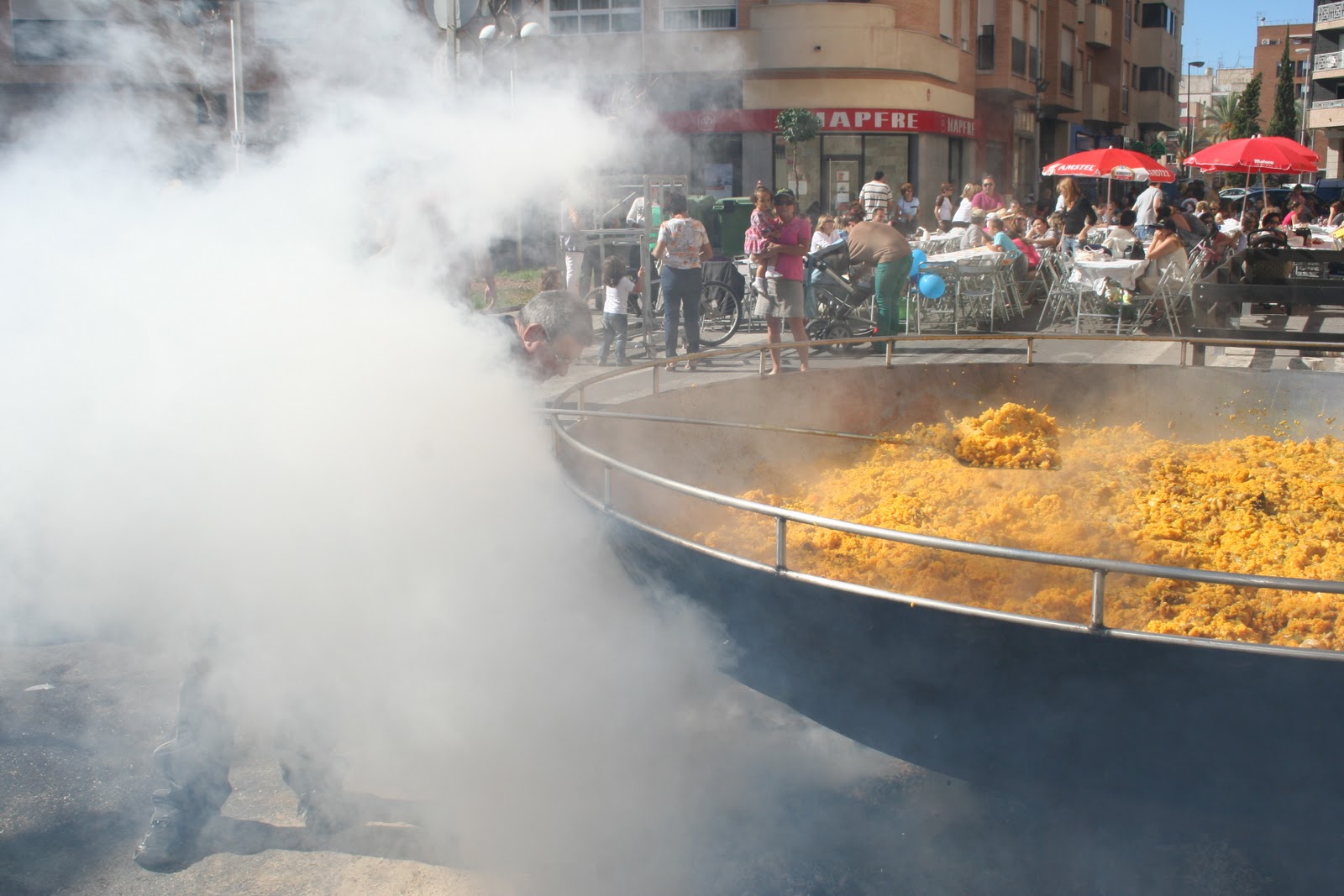
The first thing you'll need to do is close the street. (I did say it was a paella monumental, didn't I?) Light a fire and a heat up a suitably sized paella pan. The one in the picture can cater for 6,000 hungry mouths, although today it's 'only' feeding 2,000. So, oil the pan and throw in some chicken to fry gently.
Next comes the veg (verduras) and the Spanish are particularly keen on green and butter beans, so throw the box in.
A pinch of saffron (azafran)...
Rice (arroz) of course.
Then stir...
   
Finally, you can enjoy paella hot or cold. Traditionally it was a lunchtime meal for the farmers out in the fields. These paellas monumentales are often held as fundraisers, especially for the Fallas builders in the Valencian region. Everyone is welcome, and a 3 or 4 euro ticket will get you a plate of paella, a drink and a place at the hottest table in town. 
It can take over an hour to cook, so usually there will be some 'regional entertainment' to keep you occupied while you build up an appetite.

¡Disfruta! (Enjoy!)


If you like the blog why not read the eBook? Zen Kyu Maestro, An English Teacher's Spanish Adventure available from Amazon. 
For a free sample chapter, click HERE.


Saturday, 4 February 2012

La Magia de la Copa. The Magic of the Cup.

I've never been to an FA Cup final. Not even a semi-final. I've been to Wembley (the 'old' one), but usually to see England play. I was there with my dad in October 1973 when England drew with Poland and so failed to qualify for the 1974 World Cup finals in (West) Germany. That was the night that the Polish keeper, Jan Tomaszewski (dubbed a 'clown' by Brian Clough) saved everything (except Allan Clarke's equalising penalty). It's hard to describe the shock that descended over the crowd at the final whistle. I remember seeing men crying on the terraces. Nobody, nobody had contemplated such a result. England? World Cup winners in 1966. Quarter finalists in the heat of Mexico in 1970. Failing to qualify for the 1974 finals? England?!

I loved everything about Wembley Stadium (before that night). If I stood on tip-toe and looked out of my bedroom-window in our house in West-Hampstead, I could just see the twin towers. In later years, when Queen or The Who played there (Wembley Stadium), I could sing along to the songs from our front garden. I loved the tube-ride from Kilburn to Wembley Park, the walk up Wembley Way, the sight of the twin towers, and then the perfect green turf under the floodlights. We usually stood at the tunnel end. We usually stood in the upper tier (it was cheaper).

I didn't know at the time but the 'old' Wembley was (in)famous for its shallow 'rake' (the angle at which the terraces slope up, away from the pitch). If we were slightly late arriving, especially for a 'full-house' (100,000 in 1973, with 55,000 of those standing behind the goals) then the view you got from the back wasn't much of an improvement on the one I got on tip-toe from my bedroom window. The dog/speedway track surrounding the pitch added yet more distance between the crowd and the action. I was rarely certain who'd scored at the far end at Wembley. Sometimes, I wasn't that sure who'd scored at the near end...

All this is by way of introduction to the Copa del Rey, the King's Cup. (The Spanish equivalent of the FA Cup). When Valencia and Barcelona were paired for a semi-final at 9p.m. on a Wednesday night, I wondered if this might just be my chance to make it to a (Spanish) FA Cup semi-final. I've used Valencia's website numerous times so I gave it a go at 8.44 on the Monday morning (as instructed). Within ten minutes I'd bagged a couple of seats in the back row of the upper tier of the main stand, at 60 euros a go. At lunchtime I popped out to an ATM and printed them out. So, here I am again, in the back row. And while there are some similarities between Valencia's Mestalla (pr. Mess-tie-yah) stadium and the 'old' Wembley, there is one crucial difference...

The Mestalla is a 'city-centre' ground, although when it was first built (1923) it was on the outskirts, even taking its name from the irrigation channels that took water to the orange trees and the tiger nut plants in the vicinity. After much damage during the civil war (when it was used as a concentration camp) the ground was rebuilt and improved a number of times as the city grew around it. Today it has a 55,000 capacity and (the crucial difference from Wembley) one of the steepest rakes I've ever experienced.


The rake of the top tier is so steep that each seat has its own guard-rail. There's a 'fairground-ride' feel to sitting there, especially if it's a night-game and there's a stiff wind blowing in from the north.

The similarities with the old Wembley are quite surprising as well. The first is something I remember fondly from my visits with my dad, but also from watching Cup Final Grandstand year after year during the 1970s. A marching band. The marching band at the Mestalla doesn't quite live up to my recollections of Cup Final day in England. It doesn't have the 'inch-perfect' precision and 'spit 'n' polish' poise of the military bands which always graced Wembley. The Mestalla's band, which toured the pitch before kick-off and at half-time, is a much more relaxed affair. The marching lacked a certain co-ordination, it's probably over-egging it to call it marching at all. But I did enjoy the way they stopped every twenty metres or so, faced the crowd, and took some fairly generous applause. It was wonderful. A trip down memory lane on the one hand, but a touching glimpse of a rather 'gallant' Spain as well.


One of the other similarities with the old Wembley isn't quite so gallant. My Spanish isn't great, I wasn't able to make a lot of sense of what Valencia's 'ultra' supporters were chanting most of the night, but I did manage to catch a couple of ditties. Gerard Piqué, Barcelona's centre-back took a lot of stick, or rather, his girlfriend Shakira did. "Shakira es una puta," sung to the tune of Guantanamera really isn't very gallant. (Translation? "Shakira is a whore"). No, not very gallant at all. Trouble is, Guantanamera is a particularly catchy tune, and the Valencian ultras were singing it so often, I knew I'd have to be on guard for the rest of the week that I didn't start singing it in class! 

Still, the crowd did redeem itself somewhat when Pinto, the Barca keeper, raced out of his penalty area and clearly handled the ball. The árbitro failed to spot any offence at all and the Mestalla erupted in fury. "The referee's a w@ñ%ǝᴚ!" would've been the automatic response at Wembley from at least half the crowd. Not at the Mestalla. Everyone (there's very little travelling support in Spain) joined in a resounding, braying chorus of "Burro, Burro!"  ("Donkey, donkey"). In all my years there with my dad, I've never heard a Wembley crowd singing, "The referee's a donkey." 


The game ended in a 1-1 draw, or empate a uno as they say around here. The second leg at the Camp Nou next week will settle things. (See Messi's penalty attempt, video, above). 

In the car on the way home, Linda and I considered one final similarity on the route to cup glory. Giant-killing. The other semi-final is between Athletic Bilbao and Mirandés del Ebro. That's Mirandés del Ebro, top of the Spanish Segunda B division. The name Segunda B might give you the mistaken impression that it's the Spanish second division, but beware. As in England, where the first division is called the Premiership, the second division is the Championship, the third division is the first division and the fourth division is the second division, Spain also has a crazy way of naming its football divisions. The Spanish first division is called La Liga. The second division is called Segunda. The third division is where sense leaves the system as this is the Segunda B and is actually four regional divisions. (Just to complete the madness, the Spanish fourth (regional) divisions are called Tercera, which means third).

So, Mirandes del Ebro are from the third division of any sensibly named league system. The equivalent of Charlton (top of the English third (first) division) playing Manchester United (second in the first (Premiership) division). "Yes, but that's the magic of the cup, isn't it?" you might say, until you hear that Mirandes del Ebro have already beaten Vila-Real (currently 18th in La Liga), Racing Santander (17th) and Espanyol (5th). That's the equivalent (in league positioning) of Charlton beating Blackburn, Bolton and Newcastle (all over two legs) on their way to a cup semi-final. That's not magic. It's miraculous.

So, what are the chances of Mirandes del Ebro making it to the King's Cup final? Well, on Tuesday night they trailed Athletic 0-2, until the last minute, when they pulled a goal back. All now rests on next Tuesday's second leg at Athletic's intimidating San Mamés stadium. Unlikely that Mirandes will be able to turn it around. Almost impossible.

But then I do remember one night, October 1973, Wembley stadium. (The 'old' one).

A post script. Like the 'old' Wembley, the Mestalla is soon (or not so soon) to be the 'old' Mestalla. Work began on a new, 75,000 Mestalla on the western outskirts of Valencia in August 2007. Less than two years later, in January 2009, work was suspended when the failure to agree the sale of the old Mestalla before property prices crashed in Spain left the economics of the move untenable. The planned opening of the stadium at the beginning of the 2010-2011 season came and went with work still paralysed. After nearly three years of inactivity, an agreement has finally been reached and the new opening date is now set for the start of 2014. 

Another one. One week later, Mirandes del Ebro's King's Cup dream ended, beaten 6-2 in the second leg in Bilbao. Valencia also bowed out of this year's competition, losing 2-0 in the Camp Nou. So a repeat of the 2009 final where, controversially, the Catalans and the Basques booed the Spanish national anthem (in the King's Cup), and Barca took the trophy, 4-1. As Spain has no 'national' stadium, the final was played on neutral ground...

And where else, but the Mestalla.

If you like the blog why not read the eBook? Zen Kyu Maestro, An English Teacher's Spanish Adventure available from Amazon. 
For a free sample chapter, click HERE.


Sunday, 29 January 2012

Before the Fallas.

Falleras pose at the City of Arts and Sciences (La Ciudad de las Artes y de las Ciencias), Valencia.

 Most people know about the Fallas. The pyrotechnic madness that engulfs the city of Valencia between the 15th and 19th of March every year, with the giant 'Fallas' statues burning at midnight on the 19th, the feast of San José.
But did you know that there's a lot more to Fallas than that? In November, the new Falleras start their processions (desfiles) for the first (but by no means the last) time. Falleras are the respresentatives of each Falla (club), and wear traditional Valencian costume. Most Falleras are female although there are always a number of boys/men as well. Speaking to a number of parents of Falleras in our school, we've learned that an 'average' Fallera dress costs 3 or 4 thousand euros, but that you can pay a lot more than that for the finest silk.
Avoid the crowds. Local residents enjoy the parade of Falleras infantiles in Burriana.
We stumbled upon this procession of Falleras infantiles in Burriana, out for the first time in their finery. If you're travelling in the Valencian community any time between November and March, it's worth enquiring at the local oficina de turismo to see if there is a parade in the offing. 
It can take many hours to prepare for the big moment.
Remember, Valencia isn't the only town/city to do Fallas. Many of the other towns in the Comunidad Valenciana are also involved. The crowds are much smaller and the atmosphere more 'Spanish' without the hordes of tourists. Check out towns such as Gandia, Oliva, Dénia, Benidorm, Burriana, Vall d'Uixó, Benicarló and others, to escape the masses of tourists and experience a smaller, but more authentic Fallas.
It might only be November, but it's still a big day for these young Falleras.


A note on pronunciation: Spanish has some very simple, but elegant rules on pronunciation. One of the easiest mistakes to make is to pronounce 'll' as we would in English. In Spanish, 'll' makes a sound like an English 'y'. Try saying 'Fly-ass' with the stress on the 'fly' but don't make the 'l' sound. Now you can say Fallas perfectly.
As for Falleras, try saying 'Fly-air-ass', again without the sound of the 'l', but this time stress the 'air' syllable. Beautiful! 
(The Falleras, that is, not my Spanish accent!) 

If you like the blog why not read the eBook? Zen Kyu Maestro, An English Teacher's Spanish Adventure available from Amazon. 
For a free sample chapter, click HERE.


Saturday, 14 January 2012

Some things are better left untranslated


This sign hangs outside a gymnasium near where we live. Ho ho, very funny, but it got me thinking... about Spanish pronunciation (we all have our little quirks). 
I couldn't help noticing how disappointing it was that the 'joke' sort of failed because in Spanish it wouldn't be pronounced the same as it is in English. The 'Arse' bit, would in fact be pronounced ar-seh, as the 'e' is always sounded in Spanish, unlike in English.
'Gym' doesn't travel seamlessly from English to Spanish (and vice-versa) either. In Spanish it would be heem, with a bit of Scottish throat-clearing at the beginning. So, the very Anglo-Saxon Arse Gym, ends up being Ar-seh hhheem, in Spanish. Such a shame!

But, don't despair! There is a bit of humour to be had once you've gone through to departures at Palma de Mallorca airport. For there, you can enjoy a café con leche or a bocadillo de jamon at a rather splendidly named cafetería.
Sadly, while the Spanish pronunciation is pretty near perfect for our chuckling English ears, the spelling does spoil the fun again. But never mind. Now, what was the name of that cafeteria? 

Oh yes...


Chocolate cake, anyone?

If you like the blog why not read the eBook? Zen Kyu Maestro, An English Teacher's Spanish Adventure available from Amazon. 
For a free sample chapter, click HERE.


Wednesday, 28 December 2011

The Things They Say... (Part 1.) Un Cordial Saludo...

I've been learning Spanish during the five and a half years that I've lived here. It hasn't been easy, but then I haven't actually used the study methods that I remember using when I was a student (albeit not of languages), now about thirty years ago. People say it's easier to learn languages when you're young. Believe them.
Another factor which has slowed down my learning is the fact that I teach in English all day long. So, while the seven year-old Spaniards in my class are immersed in English, so am I. The children (unwittingly) don't help either. They seem to pick up English so quickly, remember it almost effortlessly, that my oh-so-slow progress seems oh-so-dishearteningly-slower in comparison. Hang a line of towels out during a shower of rain and some of the drops will miss, some will bounce off, but in the end, the towels will all get wet. This seems to be the way the children in my class 'soak-up' English in my lessons. I, on the other hand, feel like a sheet of plastic flapping in a thunderstorm; I get enthusiastically drenched, but by the next day, I'm bone dry.
Having said all that, I do learn a few things from them in class, especially when they occasionally(!) 'lapse' into Spanish. It's funny what you discover about the Spanish language when this happens.

It's noticeable how 'formal', almost archaic, Spanish sometimes sounds. "¿Ees obligatorio, I go out?" Manuel asks me one cold, December morning. By 'cold' I mean the children's definition. To me, it's a bright, sunny, (although slightly 'chilly') day. The thermometer in my car said 14 degrees on the way to school, so by now it must be nearer 18 or even 20. Can you imagine a seven year-old in an English class asking if it was 'obligatory' to go outside? Highly unlikely in the schools I've taught in back home. 'Ohhh, do I have to?' would be much more common.

"Pablo, heem ees castigado en espanish," María tells me with barely disguised glee, as I pass the frazzled-looking Spanish teacher exiting my classroom. I can't even imagine a member of staff in the UK saying they'd 'castigated' a naughty child. 'Told-off' would be more usual, although in my previous school (Norfolk) 'wronged' was an occasional (very regional) alternative.

The children in my school here are a pretty placid lot. There's not much scrapping in the playground. When it does get a bit heated, the Spanish equivalent to 'Calm down,' or 'Keep your hair on,' is '¡Tranquilo!' (Pr. Tran-key-low). It sounds even more ludicrous if I imagine the year fours back home shouting 'Tranquil!!' as they face up to each other over a disputed off-side decision.


Even the parents sometimes contribute to my education. I love it when they send me e-mails. I'm usually addressed as Estimado Señor Dean, which fills me with a foolish amount of pleasure. I'm also delighted at the end as I'm usually offered 'Un cordial saludo,' as a sign-off. I wonder if the English-speaking Spaniards get as much pleasure when I use 'Dear' and 'Yours sincerely'.

There's another slightly quaint usage I've noticed on the television, when I'm watching the football. The ball is usually called el balón or la pelota. Every so often, however, to spice things up a bit, the commentator will describe Messi dribbling with el esférico. I've never heard Clive Tyldesley roaring that Rooney has thumped the 'sphere' into the net.

It can have its uses though, this slightly old-fashioned collection of English look-a-like and sound-a-like words. On the bus one day, returning from a trip to the theatre, I heard a shout go up from the back seat. I only caught one word but it told me all I needed to know...
¡Vomitar!
I won't post a photo with this entry. I hope you don't mind...

If you like the blog why not read the eBook? Zen Kyu Maestro, An English Teacher's Spanish Adventure available from Amazon. 
For a free sample chapter, click HERE.


Thursday, 15 December 2011

The Spanish lottery, ONCE bitten...

At Xmas time, even the BBC usually finds time to run a piece about Spain's el Gordo lottery. El Gordo ('the fat one') captures headlines around the world. The annual Xmas draw (run by Loterías del Estado) is held on December 22nd and (it seems) has all of Spain tuned in or turned on to hear schoolchildren sing the numbers as they are selected in a day-long ceremony. The three billion euro prize fund attracts huge numbers of players. Factories, offices, sports clubs, it seems as though everyone has a stake, often as part of a work-based syndicate. The Spaniards even make their gambling habits 'communal'.
But while el Gordo usually makes the headlines, due to the huge amount of money to be won, Spain has another, lesser-known lottery story, which deserves our attention.
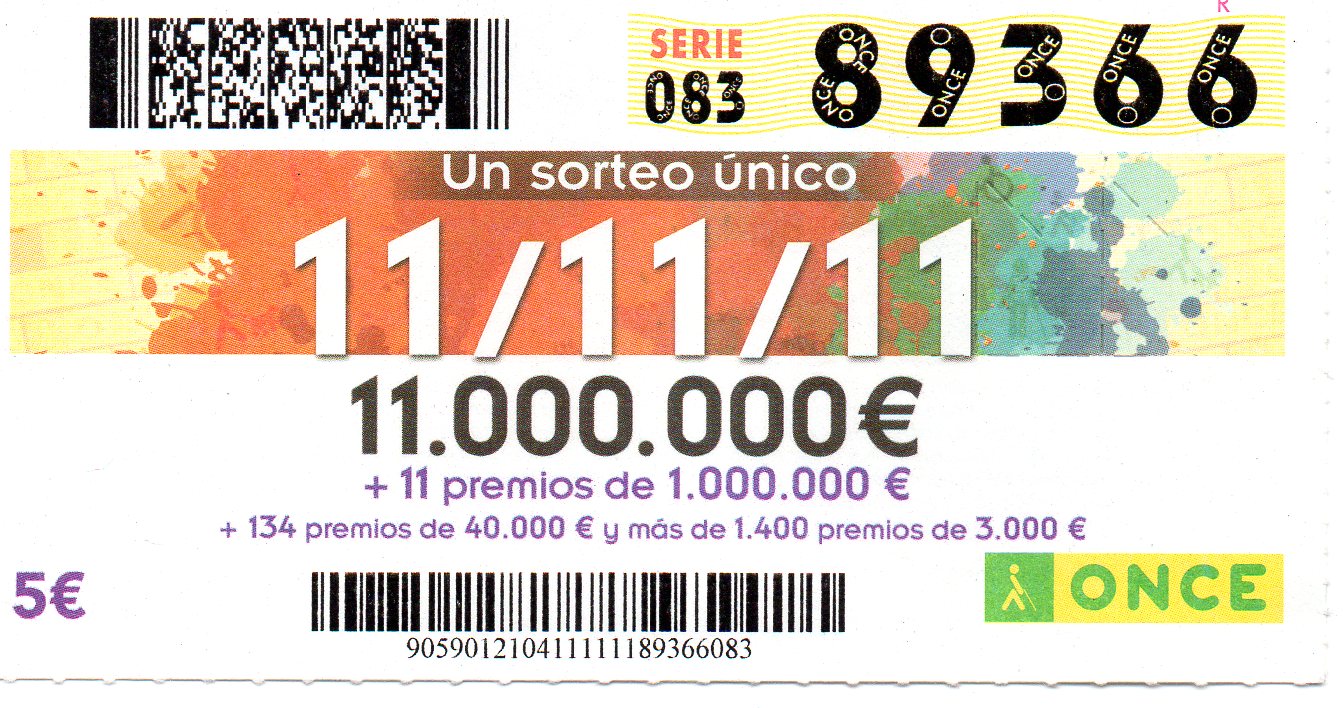
As I entered my local centro de salud (health centre) the other day, I greeted the ONCE lottery ticket-seller with a cheery, "Hola." Then, I took a snap decision. I stopped, and bought my first Spanish cúpon de lotería (lottery-ticket).


Well, it was the 11/11/11 draw, which the TV adverts had been plugging all week, and it was a good chance for me to practise my Spanish with the ticket-seller...

ONCE is a rival lottery to Loterías del Estado, and it's their story that I'm going to tell. Let's start by getting the pronunciation of ONCE sorted out. If you're an English-speaker, forget your English. Try saying 'on-say' while stressing the 'on' part and lisping the 'say'. That's better. Now, let's see what it means.
Once is the number 'eleven'. But ONCE has a different meaning. It's an acronym for Organización Nacional de Ciegos Españoles, which translates as The National Organisation of Blind Spaniards. It's the Spanish equivalent of the UK's RNIB (Royal National Institute of Blind People). But that's where any similarity between the Spanish and the UK organisations ends. For while the RNIB is best know for its work offering support and advice to blind and partially sighted people in the UK, ONCE (while performing similar functions in Spain) is undoubtedly better known for selling lottery tickets and giving employment to its members.

Founded in 1938 (during Franco's dictatorship) to aid the increasing number of Spaniards blinded during the civil war, a decision was made to award ONCE the right to run a national lottery, and benefit from the profits. Its green kioskos and walk-about ticket-sellers are now national institutions. And due mainly to ONCE's involvement in the lottery administration, the unemployment rate of Spain's blind people is zero. In the past, blind people were often reduced to the role of beggars. Franco's legacy in Spain may not be a source of much national pride, but the decision to award the lottery to ONCE has certainly turned out to be something which modern Spaniards can be proud of.
I can't help feeling that John Major missed a trick in 1993 when his government awarded the licence to run the UK lottery to Camelot (a consortium of companies including Cadbury Schweppes). Despite the money pledged to 'good causes', I always found buying my lottery tickets in the local newsagent or off-licence, to be a slightly tawdry affair, smacking of a desperate urge to 'escape' from the rat-race with a bag of Hula-Hoops and a million pounds. 
Back here in Spain, as I chatted to the partially-sighted seller outside my local centro de salud, I could sense his own feelings of inclusion and worth as he offered me advice regarding which tickets might be lucky, and explained how I would go about claiming my prize... 


My new friend outside the centro de salud offers advice and information (and Spanish practice).

And, ¡sorpresa, sorpresa! (surprise, surprise) I'm a ganador (winner). The last number on my ticket matches the last number drawn so I win... 5 euros, exactly what I'd paid for the ticket in the first place. (Top prize for this draw was eleven million euros).
So what do I do with my prize money? Well, I have another chat with my new friend outside the centro de salud and decide on two, 3 euro Cuponazo tickets for the following Friday. He's helping me with my Spanish practice, I'm another friendly customer chatting in the November sunshine.
Isn't that what they call, "Win, win"?


 A punter tries his luck at an ONCE kiosco near Valencia train station. The advert on the side boasts, 'ONCE ticket. You win, we all win'.

If you like the blog why not read the eBook? Zen Kyu Maestro, An English Teacher's Spanish Adventure available from Amazon. 
For a free sample chapter, click HERE.