Thursday, 17 October 2013

Bull-running... for kids!


Hemmingway introduced the world to running with bulls at Pamplona’s annual San Fermin fiesta (in which you can risk your life in front of a herd of charging ‘toros’). But did you know that there is a much more ‘animal (and human!) friendly’ version? One in which the only screaming you will hear will be the intense piercing squeals of young children having devilish fun... and where the only bulls involved are on wheels!

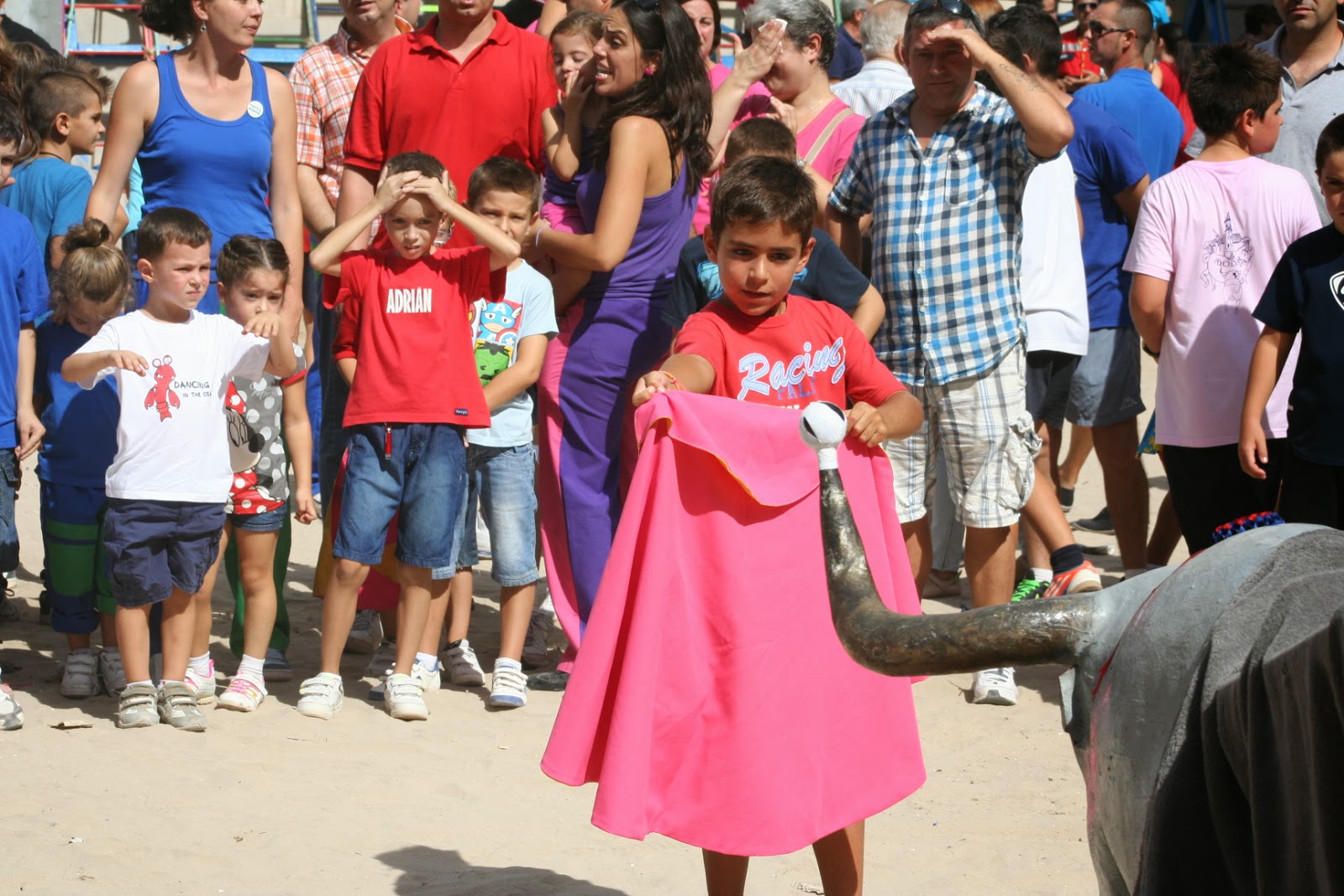
Encierros infantiles’ or ‘children’s bull-runs’ are becoming an increasingly popular part of those Spanish fiestas which include bull-running (which are by no means confined to Pamplona). I was in the Valencian community during the summer and saw encierros infantiles advertised in the local press almost on a daily basis. I popped along to the small town of Nules (population 13,000 and pronounced noo-les) to see what all the screaming was about.

I arrive early and find the town set up for a week of full-blown bull-running. The pretty main plaza (the size of half a football pitch) is dominated by the ayuntamiento (town hall) boasting bell and clock towers. But today the plaza is made smaller by the cadafales which have been erected around its perimeter. Cadafales are cages made of steel bars, thick enough to withstand an assault by an enraged bull. On top of the cadafales the genteel folk sit and sip cañas, while underneath the young and the brave (some may say foolhardy) seek refuge when the bull gets too close. The cobbles are liberally sanded and it seems as though every child from miles around has come to make sandcastles. But don’t be fooled, a white van pulls up in the corner and the castillos are trampled in the stampede.


       From the van emerge the Bou Per la Vila (Bull in the Town) team, a heavy-duty sound system and half a dozen carretones taurinos (bulls-on-wheels). The excitement level of the couple of hundred children in the square ratchets up a couple of notches as the back-doors of the van swing open to reveal the bull-heads, with horns topped by golf-balls. Who said élf ´n´safety never made it to Spain? The sound-system booms into life, Gangnam-style, and babes in arms have their photos taken by proud parents in front of the waiting carretones. Red neckerchiefs (similar to those worn by the San Ferminers) are given out and a quick warm-up session is attempted before mayhem takes over. And then it begins; the screaming goes Richter, the bulls are on the move.


The older children, anyone over about 10, run towards the bulls or after them. Younger children, the 7 or 8 year-olds, generally seem to run away. Anyone younger than that (who is able to run) doesn’t seem to know what to do, and usually ends up running around in circles, screaming their head off. If you take your eyes off the bull for a second, you will see that the adults carrying babies, or holding the hands of 5- or 6-year-olds (to keep them ‘safe’) are actually having as much fun as the children.


At a given signal, the carretones charge en mass up a long side street, followed by what must now be three or four hundred children (and adult ‘carers’). All goes quiet for a brief couple of moments before the crowd spews back into the plaza pursued by the bulls, like an uncorked Cava bottle.


There is a call on the PA for ‘toritos pequeños’ and anyone who has brought along their own mini bull on mini wheels is now welcome to join in the mayhem. Adults chase children. Children chase adults. Bulls chase bulls. Some children have brought capes while others are even riding the bulls!

The Bou Per la Vila team then defy all known laws of child-psychology by asking the hyper-excited children to form lines for individual ‘runs’ against the bulls. This won’t happen, my experienced-teacher’s brain tells me, confidently. And I am wrong.

I have to confess, I’m no fan of bull-fighting or (adult) bull-running, but for an evening I regret bitterly that I was born and brought up in Cricklewood, rather than Nules. It seems to be the most fun it’s possible to have as a child, without actually doing anything ‘wrong’. 


I shot some video in Nules. It'll give you a pretty good impression of the atmosphere:

Nules night run

And here's the 'real thing', an adult 'bull-run' from the nearby town of Burriana:

Burriana run 2013

But be warned... There is no doubt that the encierros infantiles escapades, while being good, clean fun for all the family, are also the perfect recruiting sergeant for the next generation of (adult) bull-runners. These events bring people (and therefore money) into the small towns that host them. Just don’t be fooled into thinking that the adult events are the same ‘fun’. Four days after my afternoon in Nules, a local man was killed in that day’s run.


So, if you want to experience Spainish ‘toro’ culture in a safe (if noisy) way, then take my advice and ignore the bull-ring with its blood and gore, and instead seek out an encierro infantile for all the family to enjoy. They’re especially common in the summer months, in the towns inland from the packed beaches. Take a break from the sun, sea and sand... and run!

Read more of my adventures in Spain in my eBook, Zen Kyu Maestro: An English Teacher's Spanish Adventure. Click on the cover for more details:

  
http://goo.gl/AC13i

Monday, 16 September 2013

The Things They Say (Part 10) 'The vest of the world...'

'My teacher is the vest of the world,' wrote Veracruz this afternoon.

Once I'd remembered that 'v' and 'b' sound almost the same to my 6-year-old Spaniards, I felt a little better...
On the other hand, it's been very hot this first few days, there's no air-conditioning in my class, the sweat has been flowing freely... so maybe, just maybe, she meant exactly what she'd written...

An extra dab of deodorant tomorrow, perhaps, just to be sure.

If you like the blog why not read the eBook? Zen Kyu Maestro, An English Teacher's Spanish Adventure available from Amazon. 
For a free sample chapter, click HERE.


Friday, 13 September 2013

A Teaching Moment in Time, the TES, 13-09-2013


It's playtime, or 'patio' as my new class continue to call it. The sun beats mercilessly on the tarmac and the children seem oblivious to it, unlike the (mostly British) staff. I'm wearing my sunhat, sipping my water, hiding behind my sunglasses, and sheltering in the slim strip of shadow provided by the primary building.
Out in the glare, the activity is as intense as it always is. Two-thirds of the boys are pretending to be Iñiesta, Xavi, Ronaldo, Villa... How they can run and jump and tackle and kick in the heat, I don't know. There are basketball players throwing basketballs, gymnasts cartwheeling, skippers skipping, chasers chasing and disco dancers twirling and whirling in (near) unison... It makes me sweat just watching it all.
A gang of small girls pelt towards me. They seem barely able to move their legs fast enough to keep up with the speed their upper bodies are going at. I'm sure, any second, I'm going to be dealing with grazed knees, missing milk-teeth and small grit-encrused palms. 
But they skitter to a breathless halt without mishap and gasp the request that always seems to be the highlight of their day.
'We reeeng da bell?'
I look at my watch. Rub my chin thoughtfully. Strictly speaking there are three minutes to go. The infantas hop from foot to foot with barely contained expectation and excitement. Out on the Camp Nou pitch an attacker has broken free and is bearing down on goal. A skipper is getting breathless counting towards their target, '85, 86, 87...'
What a joy it is to share such pleasure at such small things.

A lesson to us all, perhaps?

If you like the blog why not read the eBook? Zen Kyu Maestro, An English Teacher's Spanish Adventure available from Amazon. 
For a free sample chapter, click HERE.


Saturday, 22 June 2013

The Things They Say (Part 9) Mischief in the Playground


La señora Pérez is very agitated this morning, and young Rafa is looking cross. He’s got his arms folded tightly and a stiff pout squeezing all the colour out of his lips. She’s jabbering Spanish at great velocity and I haven’t understood a word. She tries to remonstrate with Rafa but he shrugs her off and stares out towards the orange trees. So she starts jabbering at me. I concentrate gamely but the sun is ridiculously hot, the sweat is pricking out on my temples and Sara is tugging at my sleeve and whining, ‘MeessaDeeeeMeeesssaaDeeeeeee.’ This is not a good way to start the day; angry parent, at least two angry children, surface temperature of Mercury reached before we even start, and me humiliated, again, by my pathetic command of a language which all the 6- and 7-year-olds in my class can use effortlessly.
La señora Pérez turns on her heel(s) and starts running, yes, running out of the playground. And suddenly I catch a word that she’s shouting. ‘¡Un rato!’ she shouts. ‘¡Un rato!’
A rat? She's seen a rat! Christ, it doesn’t surprise me. The smell from the sewers is now in peak season and easily masks the smell of all the children and teachers in a school where the only air-conditioning units are in the office areas and the SMT ‘lounge’. I noticed in the TES some time ago that SMT (senior management team) has been changed into SLT (senior leadership team) but we haven’t kept up with this ‘reform’. (It's not the only one.)
I shrug and smile at Rafa. But he intensifies his bloodless pout so I lead my group towards the class, scanning the playground for a mischief of rats as I go. Did you know that the collective noun for rats is a mischief? Well, it’s one of many actually. It’s also a colony, a horde, a pack, a plague and a swarm. Or so it says on the internet. I remember learning (some of) these nouns when I was at school. It seems to have gone out of fashion. Wonder if it’s worth bringing it back? Of course, they’d have to sort out the mess and decide on one name to learn. I mean, they couldn’t expect children to learn them all. But that would cause an almighty row, as all the pedants argued amongst themselves about which one was ‘correct’. Probably best to not bother. I’ll stick with ‘mischief’ myself. No particular reason.
No sign of any mischief in the corridor so I lead them into class and get on with the registration conversation. I’m halfway through when there’s a knock on my door and la señora Pérez bustles in without waiting for a reply. She’s breathing heavily, sweating, still muttering about the rat- and carrying a box.
Bloody hell! Rafa is suddenly all excited and pout less. He’s up off the floor, blood flooding through his lips and he's reaching for the box.
‘Woah, hold on!’ I blurt in less than fluent español, reaching out and getting hold of it without actually securing possession. Rafa has also managed to grab a corner although la señora Pérez still has a firm grip.
‘You can’t bring a-‘ I stop short of alerting the rest of the children to the fact that there’s a sharp-toothed rodent above their heads. What are they thinking? It’s not Rafa’s show and tell today, and even if it was, I’d have insisted that he bring it in a cage. La señora Pérez looks confused, Rafa is starting to pout again but I can’t let this go on. I try to give the box a good yank but only manage to twist it sideways. I feel the contents slither to one side. It’s heavy. A big one! Suddenly, la señora Pérez loses her grip. I take the opportunity to pull it out of Rafa’s small hand but I’m stretching out too far over the heads of the spellbound children on the floor. Rafa tries to strengthen his hold but only manages to grab the lid which comes off. I now have the box by one corner but the weight of it means I can’t get enough purchase to keep it from tipping-
‘No!’ I manage to blurt as the weak side of the box starts to tear and the contents tumble out, bouncing off Lídia’s head before landing at my feet...
‘Ooee!’ says Lídia, staring at a banana and the tell-tale shape of a bocadillo (sandwich) wrapped in silver foil.
‘Oh!’ I say. ‘I thought you said-'
Rafa starts to gather his bocadillo and (rapidly bruising) banana. ‘My marm, she olvida my esnack!’ he snarls to himself. (My mum forgot my snack.)

Note to self. The Spanish for ‘rat’ is rata. The Spanish for ‘mouse’ is ratón. I knew that last year. I'm sure I did!
And un rato? Well, that actually translates into English as... ‘a short while’.
Good idea not to mix them up.

If you like the blog why not read the eBook? Zen Kyu Maestro, An English Teacher's Spanish Adventure available from Amazon. 
For a free sample chapter, click HERE.


Monday, 17 June 2013

The Things They Say (Part 8) When?

'You can take your picture home tonight,' I tell Pepa, who's obviously very proud of her work.

She looks up at me, a crease of concern on her brow. 'Is tonight, today?' she asks...


If you like the blog why not read the eBook? Zen Kyu Maestro, An English Teacher's Spanish Adventure available from Amazon. 
For a free sample chapter, click HERE.


Sunday, 16 June 2013

The Things They (try to) Say... (Part 7.) Manuel's Vulgar Clams.


There’s quite a crowd surrounding Manuel as he bustles into the classroom this morning. What’s he got today? As usual, all the excited babble is in Spanish. I ease myself into a position so I can see above the bobbing heads. It’s a jam jar full of water. There’s something lurking at the bottom.
‘What have you got?’ I ask in a sing-song, Blue Petery, early-in-the-day voice.
Manuel holds the jar aloft and shrugs. ‘I no no weet een eengleesh,’ he says, slightly crestfallen.
A nuclear weapon of noise explodes around him as everybody gives their view of what’s in Manuel’s treasure jar.
‘OK, OK,’ I say, in a slightly less Blue Petery tone. ‘Let me have a look.’ It’s some kind of mollusc but I’ve no clue whether they’re cockles or mussels. I’ve some doubt whether they’re alive-alive-oh, given that Manuel’s had them captive for most of the weekend. Half a dozen of them are lurking in the murk at the bottom of the jar, each about the size of a butterbean.
I scan my mob for someone who might just have an edge over the others in matters mariscos. It’s not promising. I can hear lots of muttered suggestions, all of them muttered with 101% certainty, all of them different. I have to admit I’m not a big seafood eater, or an eater of big seafood, so although I recognise many of the Spanish words, I couldn’t actually translate any of them into English.
‘You see ees lengua?’ Manuel points excitedly at a creamy-coloured tongue probing out from one that is still alive-alive-oh after all.
‘Very nice,’ I say. ‘Where did you get them?’
En la playa.’
‘In English, please.’ He must know this.
‘Da bitch!’ he says, proudly.
‘Yes, the beach. Were they in the sea?’
He looks confused. ‘Dey in da warder.’
‘In the sea.’ I emphasise ‘sea’ but Manuel ignores me.
‘My dad he coger dem but my mum she say you poot hems back but my dad he say ees OK I wanna traer thems to see you and my mum she gritar when all de warder it go on the silla in coche.’ I manage to turn that lot into news that there was a family row over whether he could bring them into school which reached a peak when Manuel spilled some of the water in the car...
‘Sounds like you had a lovely day out,’ I say, and notice (the aptly named) Mar smirking. She can have a level 4 at the end of the year.
‘I’ll tell you what I’m going to do,’ I announce, before Manuel has a chance to let us all know whether the row escalated later on when he probably emptied them all out onto the dining room carpet. ‘Miss Macarena knows a lot about these things so I’m just going to pop next door and ask her while you change your reading books.’
Everyone nods that Miss Macarena is a world expert on marine-life except Marta, who’s got her hand up and a worried look on her face. ‘What is “pop”?’ she asks with a seriousness that is not normal for a 7-year-old.
‘Ummm, it means “go”,’ I say, hoping fervently that she doesn’t ask why...

‘Is almeja,’ la señorita Macarena says with calm certainty. Maybe she is a world expert on marine-life after all. ‘Bu- I no nowit een English.’
‘No matter,’ I say, pudging my phone with my index finger. ‘I’ve got a translator on this... clam! OK, thanks.’
‘Kwam?’ la señorita Mac says, looking for confirmation. I show her the screen and say, ‘Claaam,’ as clearly (and as quickly) as I can. I can hear a bit of ‘noise’ from next door...

‘Right! I’ve got it,’ I bellow above the din as I stride back into my room. There’s no blood evident and no-one’s crying so I breeze on. ‘Come and sit down for the register and we can have a little talk about Manuel’s almejas, his clams!’
A dozen permutations of the word ‘clam’ ring out as the children settle down on the floor. Pablo and Paco are arguing about which of them said ‘almeja’ earlier on. I fire up my IWB and pop- sorry, putalmeja’ into wordreference.com. ‘Come and tell us about your clams!’ I beckon to Manuel who, as always, is thrilled to have a chance to chat to a willing audience.
I carefully steer him around the family row, which evidently did escalate when Manuel dropped one clam into his granny’s lap when they went for paella after their morning on the beach. With a little prompting he manages to use words like ‘bucket’ and ‘paddle’ to describe the collecting process and the children have loads of questions about how you cook them. Then I spot Marta with her hand up and a worried look on her face.
‘Yes, Marta,’ I say.
‘What ees, “Vah-hee-na”?’ she asks.
‘Vah-hee-na?’ I repeat.
She nods.
‘Is that English?’ I ask. ‘Or Spanish?’
‘Ees English,’ she says, quietly. ‘And “fanny”?’
I feel my lower jaw dislocating from its mountings and bouncing a couple of times on my chest. She’s said it so clearly and perfectly, even stressing the first syllable as you do. Whenever you say it. If ever you say it... Fan-ny.
‘Wha- I, er, ummm, where did you hear that,’ I ask, trying to sound nonchalant, like she’s asked me what ‘horse’ means, or ‘frog’.
‘I read it,’ she says.
‘Where?’ I venture.
She points. At my whiteboard. For some spiteful reason my brain sends a cold shiver down my neck as I turn and look at word reference’s translation of almeja into clam. It’s a noun feminine, I see immediately, although I could have guessed that from the ‘a’ on the end. Then I notice an extra translation underneath. This one is also a noun feminine, but crucially, it’s also colloquial. And vulgar.
Vagina.
Jesus Christ!
‘Vah-hee-na!’ Manuel rolls it around his vocal chords. And, as I’ve taught them to do, they all start saying it with varying intonations.
‘Ees vah-hee-na, or vah-gee-na?’ Pepa asks, and I regret bitterly having spent so much time showing them how an English ‘g’ makes different sounds in words such as ‘got’ and ‘giant’.
Steven, my one British kid, has his hand up and I know for a fact he wants to tell everyone that an English ‘i’ rarely makes the Spanish ‘eee’ sound! From the evil glint in his eye I have a nasty suspicion that he also wants to provide us with a definition. But before I get the chance to shush him I notice a second extra translation of almeja. It’s ‘offensive’ apparently, in the UK at least.
Fanny.
For some reason I can’t quite fathom, this seems to be one of the few English words that Spanish kids can pronounce perfectly.
‘Fanny,’ Manuel says inquisitively, as if he’s trying to remember it so he can tell his dad (who’s also learning English) a new word this afternoon when he gets home. ‘What ees fanny?’ I pray the head doesn’t wander in to collect the register which I haven’t even started. ‘Ees animal?’
Then, I take one more glance and see a third extra translation of the Spanish word almeja and I see my career flash before my eyes, screaming wildly. The heat-induced sweat dribbling down my back is suddenly engulfed by a tsunami of the shock and stress-induced variety. I slam the laptop lid shut and yank the VGA lead out with a force that could move a fully-laden Jumbo jet along the runway at Heathrow.
‘What ees-‘ Marta starts, but I cut her dead.
‘I’ve got a wonderful surprise!’ I blurt, unsure of what I’m going to say next, but certain that it has to grab their attention away from what they might just have read on my IWB. ‘Ummmmm. We’re going to........ ummm, go out side- and- yes, have an extra playtime!’ I say the last two words with huge enthusiasm, like I’ve got a swimming pool full of ice-cream ready for them to dive into. This seems to do the trick; there is a monstrous roar of junior delight and a slight diminishing in the flow of sweat squirting out of my pores.
As I lead them out, dancing and hugging each other, I feel a tug on my shirt. It’s Marta. She has a worried look on her face.
‘What ees...’ she begins.
‘Why don’t you bring a skipping rope?’ I offer. I know she loves skipping. ‘We could play that game with the months when you have to jump in on your birthday?’ I know they all love that one. Marta looks torn. The birthday months skipping game, or that third ‘extra’ translation that she wants explained...
‘Tell you what, I’ll skip first,’ I offer.
‘Oh yes, Meesta Dee, you skeep too-‘ a whole gang of them start bellowing. And Marta is caught up with childish delight for something completely insignificant, all her thoughts about learning new words are erased, and my career survives a brush with Manuel’s vulgar clams.

If you like the blog why not read the eBook? Zen Kyu Maestro, An English Teacher's Spanish Adventure available from Amazon. 
For a free sample chapter, click HERE.


Saturday, 1 June 2013

Giant Playground Problem

So what is it this time? A fight? A runner? A stolen toy? No... Beetles!


Giant beetles, at that. Not something I can remember having to deal with in the UK during 25 years of patrolling. But here...
Manuel scampers towards me as I exit the building, donning my hat and sunglasses.
'Meester Dee, Meester Dee! Look thees!' 
It would be nice to think he's trying to say 'These,' but I know for a fact he's still saying, 'This', even though he has four beetles (giant beetles) scrambling over his palm.
'Very nice,' I say. 'Beetles.'
'Escarabajos,' he says. The children often do this. I give them the English, they give me the Spanish in return. They know I'm learning. I think it's good that they see that teacher doesn't know everything and can learn stuff from them.
I always like to chew over any new Spanish word I hear. Escarabajo? I know 'cara' means face and 'bajo' means down, so does escarabajo mean face-down? Neat. 
Neat, maybe. But wrong. I'm reliably informed that escarabajo comes from the latin, scarabaeus. Shame. 
Some kids once found a grasshopper in the playground. Quite a big one. I told them it was a grasshopper and they looked distinctly unimpressed.
'Saltamontes,' Marta told me proudly. 'Saltar', to jump, 'montes', mountains. Yes, bit more impressive than grasshopper, I have to agree.
I saw one once, in Guatamala, which looked big enough to jump a (medium-sized) mountain. Here it is...


Looking at it again, it's probably a locust. Or maybe a pterodactyl. Glad one of this size hasn't hopped into the playground. That might cause a bit of a stir, as it ate a couple of children before we teachers could fend it off with broom-handles and fire-extinguishers.

No, there's never a dull day in a Spanish playground.


If you like the blog why not read the eBook? Zen Kyu Maestro, An English Teacher's Spanish Adventure available from Amazon. 
For a free sample chapter, click HERE.